
The Global Oil Shock Is Here
This week: Hormuz never shut · Trump's Russian diesel · Heating oil up 82%
A Special Edition
The Global Oil Shock Is Here
A walk through the whole crisis, from the oil field to your heating tank, with every number checked against the latest data.
This week Crude steps away from its usual format. Instead of one story, it explains the whole oil crisis from the ground up.
The world is not running out of crude so much as running out of easy ways to move it and refine it, which means the pain lands hardest on diesel, and in Europe hardest of all on heating oil.
Shock One: The Crude Still Gets Out, the Hard Way
The Strait of Hormuz is dangerous, not shut, and that changes the whole story.
Start with the basic machine. Before the war began on 28 February 2026, the world burned about 105 million barrels of oil a day from one shared pool. So a barrel lost in the Gulf raises the price paid in Hamburg, Warsaw and Vienna.
Before the war about 20 million barrels a day left the Gulf through the Strait of Hormuz, the narrow channel between Iran and Oman. The common assumption is that most of that flow simply stopped, leaving the region with little more than shuttle tankers and the Emirati pipeline. The tanker trackers show something very different. Kpler, a tanker tracking firm, counted at least 10.1 million barrels a day of crude still crossing Hormuz, shuttle cargoes included, in the week before its note of 6 October 2026. It also had Middle East crude exports back near their prewar level at the end of September.
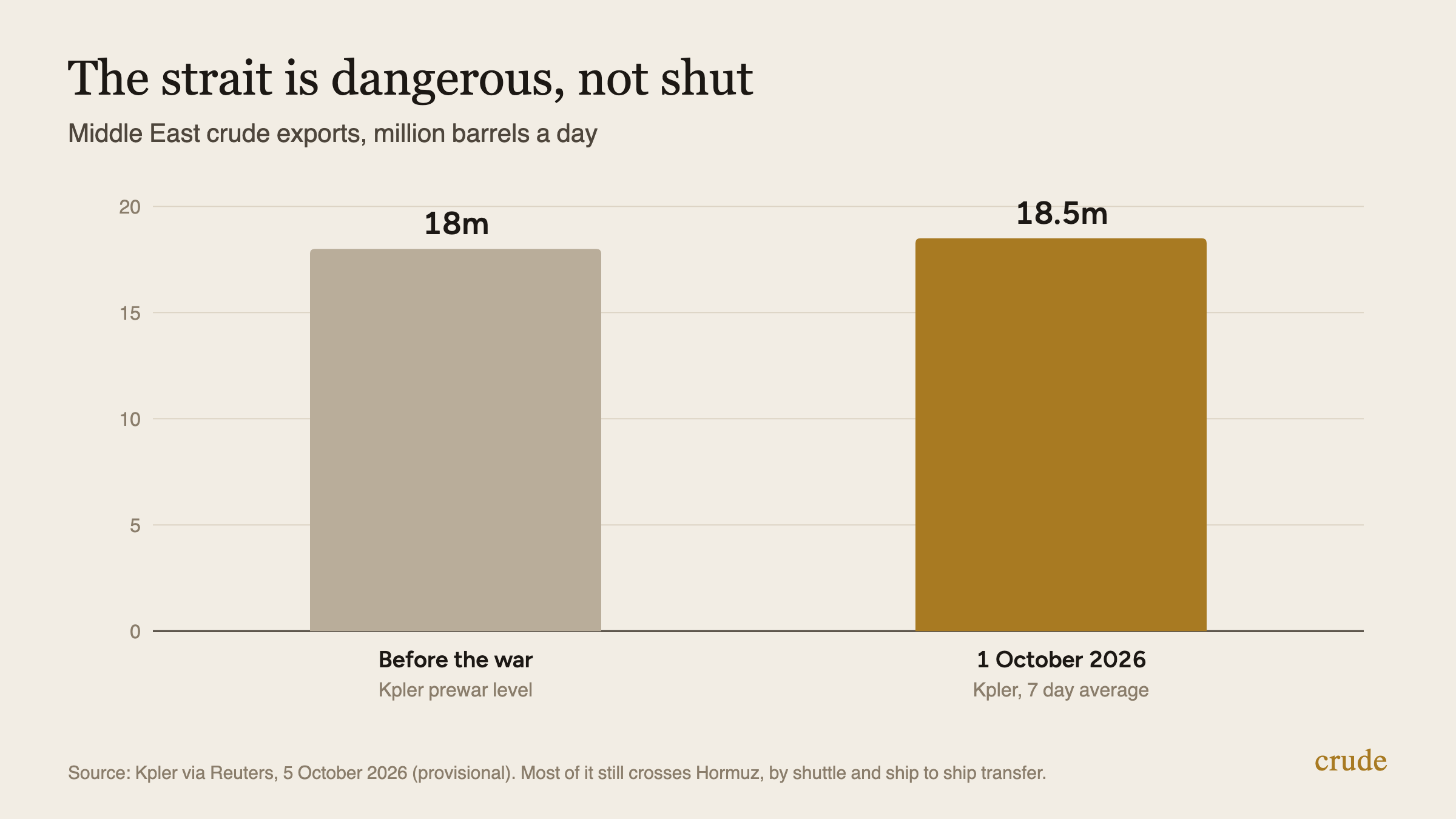
Middle East crude exports. Source: Kpler via Reuters, provisional.
So how is the oil getting out? Partly through pipelines that skip the strait altogether. The United Arab Emirates pumps about 1.5 million barrels a day through a line to Fujairah, on the open sea. Saudi Arabia's East West pipeline carries crude across the desert to Yanbu on the Red Sea. A drone attack launched from Iraq knocked it out on 10 September 2026, but it restarted on 22 September 2026. Riyadh claims it is back to 5.8 million barrels a day, while the last independent estimate, from Kpler at the end of September, was about 2.65 million.
Most of the rest moves by ship to ship transfer, meaning crude is passed between ships at sea instead of loaded at a port. Tankers, many of them supertankers themselves, shuttle cargoes out through the strait and hand them to supertankers waiting off Oman. Vortexa, another tracker, put that trade at about six million barrels a day in late September. Traders told Reuters on 25 September 2026 that it had hit its limit, with each transfer taking nearly ten days, and tanker attacks cut it further in early October.
That leaves a smaller gap than the headlines suggest. The International Energy Agency puts the world's shortfall at 1.7 million barrels a day in the third quarter, and the US Energy Information Administration expects September's gap to shrink to under one million in October. As much of the hole was filled by people using less as by new supply: the IEA estimates world demand ran about 5.8 million barrels a day below February's level for six months, as prices rationed what was left.
What that means for anyone watching the price is a split market. Brent crude futures for December settled at 104.72 dollars a barrel on Friday. Physical cargoes for prompt delivery traded far higher, at more than 125 dollars in early October, because a barrel you can actually load this week is scarcer than a promise of one in December.
Shock Two: The Ships Ran Short
When every voyage takes longer, the world effectively has fewer tankers.
Oil moves in enormous ships at roughly the speed of a bicycle, and more than four in ten of the world's supertankers are now in or near the Gulf, many waiting their turn in the slow shuttle off Oman. A ship parked for ten days to collect a cargo carries nothing anywhere else, which means the fleet has shrunk in practice if not on paper.
The Red Sea adds a second detour. The Houthis, the Iran aligned movement that controls much of Yemen's coast, seized ground at the Bab al Mandab strait in September and have blockaded ships linked to Saudi Arabia since July. The strait is often described as closed, but Lloyd's List counted more ships through it in late September than in a typical week of January. Saudi crude bound for Asia does avoid it, though, sailing north through Suez and around Africa instead, which Reuters estimates stretches the trip from about 19 days to 48.
Then comes the price of hiring a ship. The Baltic Exchange's benchmark for a supertanker from the Gulf to China reached about 1.41 million dollars a day in the week to Friday. It models a voyage few owners now make, and the more realistic Gulf of Oman route paid about two thirds of that. Nor did the surge start from a normal level: rates were already about 218,000 dollars a day on the eve of the war, because the market was tight before a shot was fired.
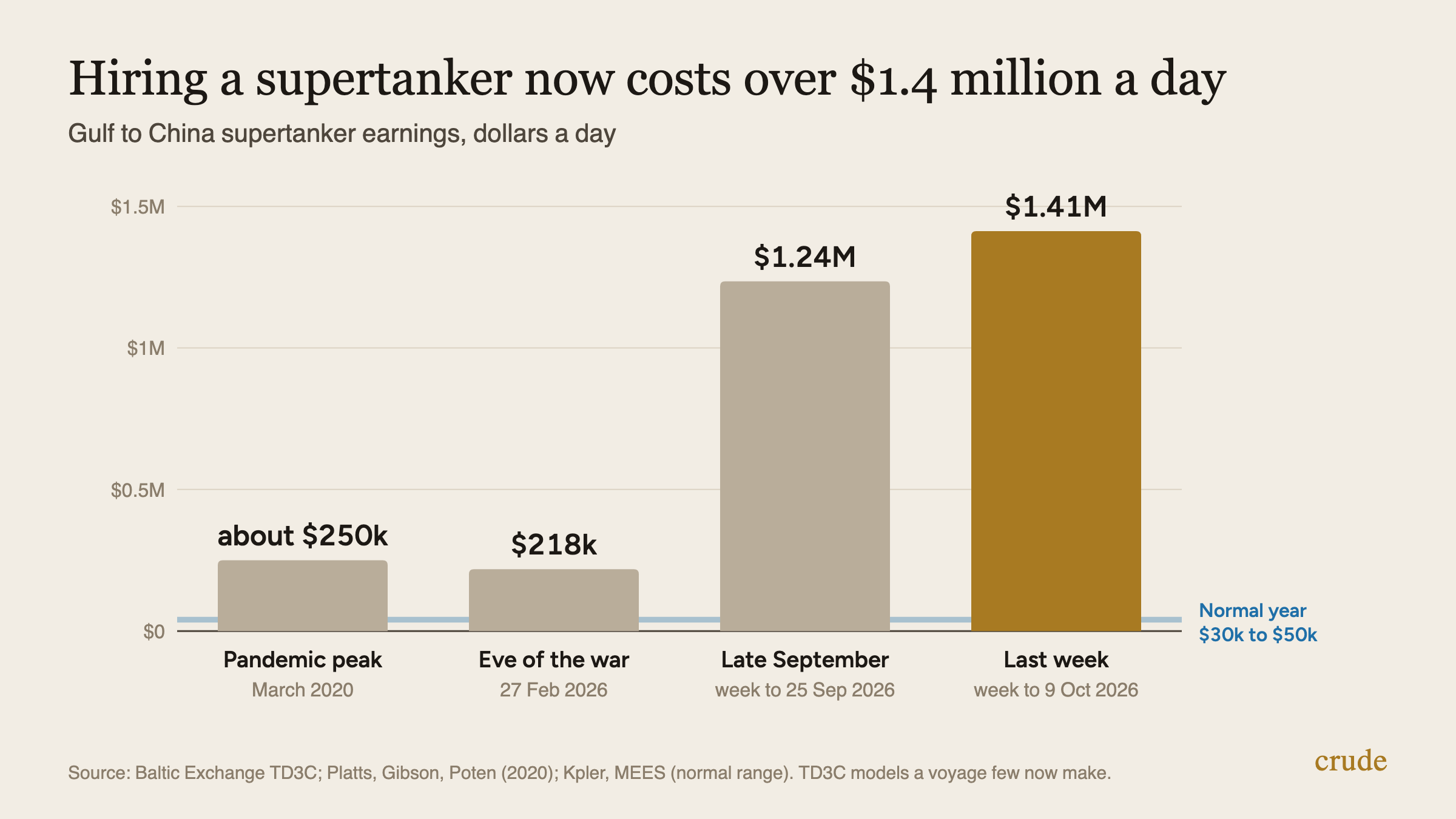
Supertanker earnings, Gulf to China. Source: Baltic Exchange and industry estimates.
For a European buyer the translation is direct. ING estimates that moving a barrel of crude from Saudi Arabia to Rotterdam cost about 2 dollars in 2025 and more than 35 dollars in September. Rates for Suezmax tankers, the mid sized ships that bring much of Europe's imported crude, more than doubled on routes from West Africa, Guyana and the US Gulf in the three days to 5 October 2026. That means Europe pays more for oil even where none of it passes a war zone.
Diesel pays this toll twice. A product tanker carrying diesel from the Gulf to northwest Europe cost about 18.4 million dollars per voyage on Friday, which works out at roughly 15 euro cents on every litre in freight alone, before the fuel reaches a single depot.
Shock Three: Diesel, Where the Pain Lands
Crude is useless until a refinery turns it into fuel, and refineries became targets.
Crude oil has to be refined before it is any use to you, and the world's largest refined product is diesel, at about 29 million barrels every day, more than a quarter of all oil demand. Diesel moves trucks, trains, tractors, construction machinery and ships, so it sits inside the price of almost every physical thing you buy.
Demand for it barely responds to price, and in the short run petrol is not much more flexible. A farmer cannot stop a harvest because fuel got expensive, and a haulier still has to deliver. So when supply falls, the price does almost all of the adjusting.
And supply has fallen, through two refinery wars at once. Ukraine has been striking Russian refineries with drones, and by late August the IEA counted 27 of Russia's 32 major plants hit, with the crude Russia actually refines down by almost a third in June. Its seaborne diesel exports fell to about 144,000 barrels daily in September, the lowest in more than a decade of Vortexa's data, partly because Moscow has also barred producers from exporting diesel until 31 October 2026. In the Gulf, the bigger problem is the choked strait rather than bombed plants, and Gulf diesel exports were running at just over a quarter of their prewar pace in August.
That is why, on Friday, the United States, which pumps more crude than any other country, struck a deal for Russian diesel. Trump announced it after a call with Vladimir Putin, and on Saturday Moscow said it would allow 500,000 tonnes of exports at this stage. Even if the first three tranches Trump listed all arrive, they add up to about eight days of the diesel Russia and the Gulf no longer export by sea, and the first is less than a single day of American diesel use.
Together, the IEA estimates, Russia and the Gulf shipped 1.6 million fewer barrels of diesel each day in August than in February. That sounds modest against world demand. Yet it is about a third of all the diesel traded by sea, and seaborne trade is the market Europe buys from, which is why a modest share of world supply produced an extreme price. China did not hold its diesel back either: its diesel exports in August were more than two fifths higher than twelve months before.
The number that captures all of this is the crack spread, the difference between the price of crude and the price of the fuel made from it, roughly what a refinery earns for the work. On 16 September 2026 New York diesel futures traded a record 114.52 dollars a barrel above Brent futures, on Crude's calculation from exchange settlements, though physical prices peaked higher in May 2022. By Friday the gap had eased to 94.29 dollars, so the peak has passed for now, though the margin is still several times its normal level.
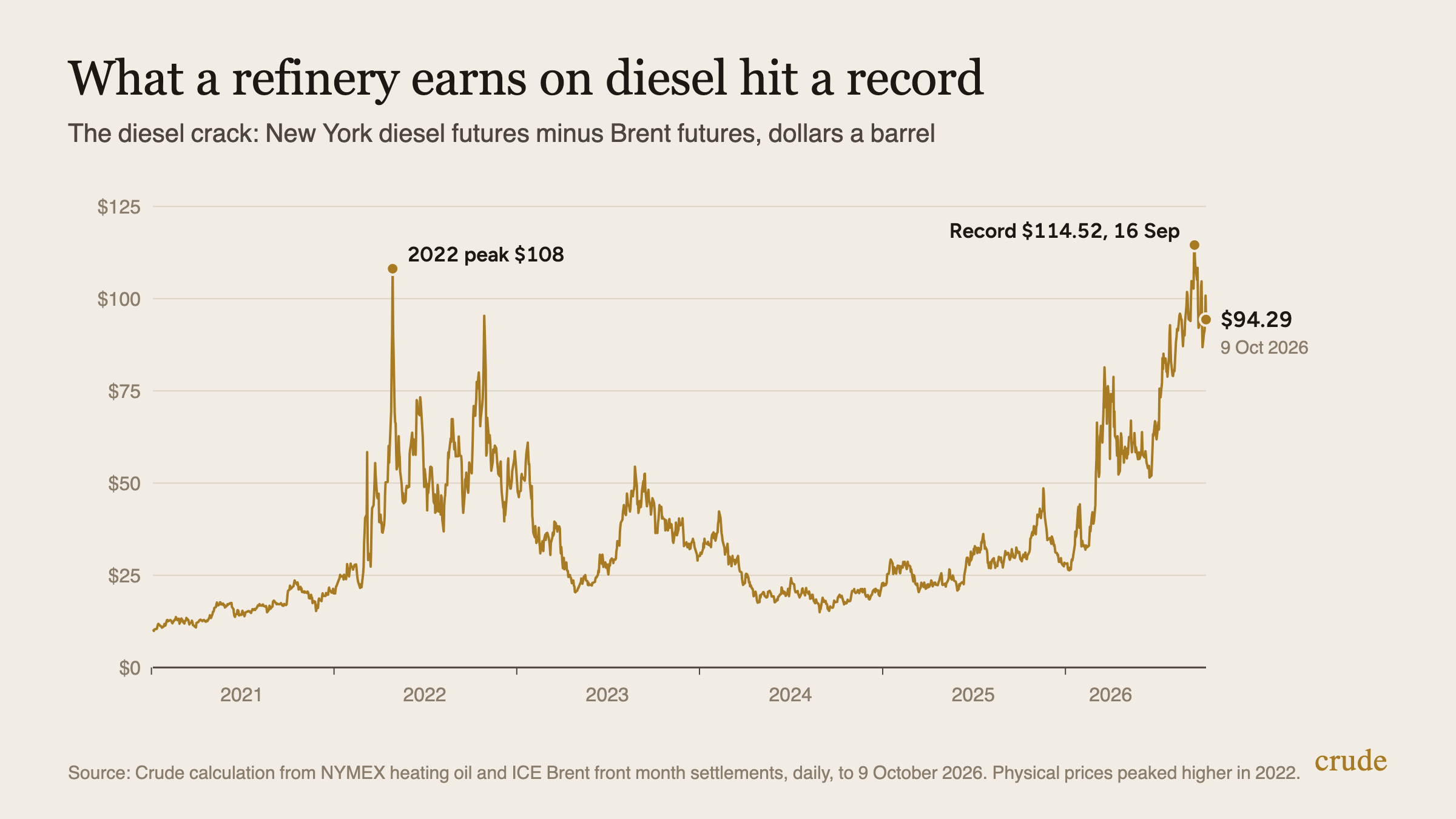
The diesel crack since 2021. Source: Crude calculation from exchange settlements.
Turned into a litre, the refining margin alone has gone from about 11 euro cents in a normal year to about 53 euro cents now. That is the 94.29 dollar crack converted at 1.1206 dollars to the euro and divided by the 159 litres in a barrel, against 20 dollars in a normal year. Crude itself, at Friday's 104.72 dollars, accounts for about 59 euro cents of a litre of diesel. So refining now costs almost as much as the oil.
The result is wholesale diesel at about twice its price of a year ago: New York diesel futures closed Friday near 199 dollars a barrel, against 96 twelve months earlier, while Brent is up about 61 percent. Diesel has doubled, not tripled, and double is bad enough.
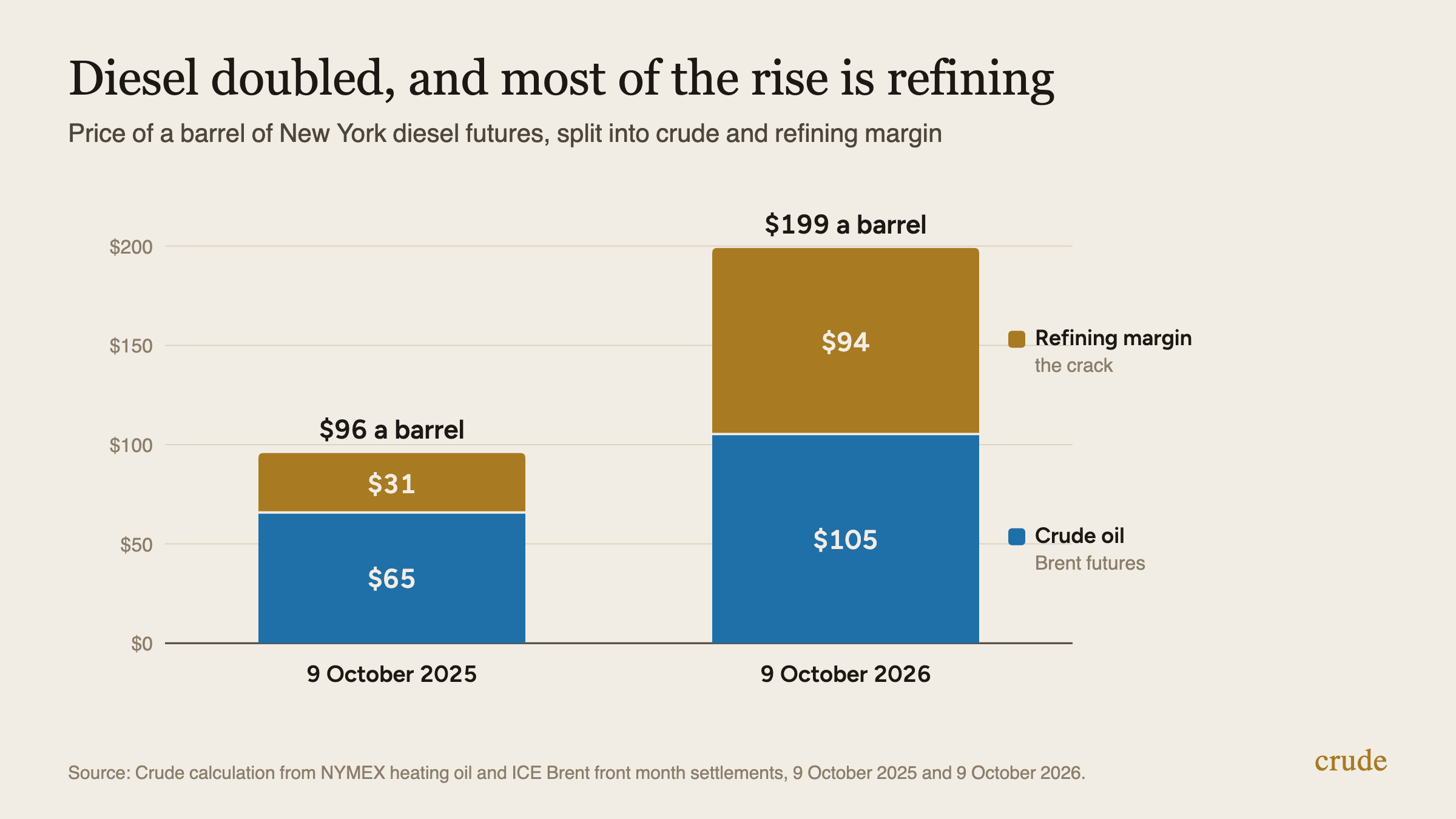
A barrel of diesel, a year apart. Source: Crude calculation from exchange settlements.
What It Means for Europe
Europe imports its diesel, taxes cushion the pump, and heating oil has no cushion at all.
Europe sits at the end of the longest version of this chain. Since banning Russian diesel in February 2023, it has relied on diesel shipped in from outside the region. In September those imports fell to about a million barrels daily, the lowest September in Vortexa's records, and 41 percent came from the United States. So a proposed American ban on diesel exports, floated in September and dropped on 2 October 2026, mattered more to European drivers than to American ones.
Friday's American licence for Russian diesel does little for Europe directly, because EU law still bans it. On Monday 12 October 2026 EU foreign ministers are due to approve the bloc's biggest round of sanctions listings on Russia since the full scale invasion. Europe gains only if Russian cargoes free up American and Indian diesel elsewhere.
At the pump, the shock is partly hidden. The European Commission's bulletin put the EU average price of diesel at 2.149 euros a litre on 5 October 2026, up two fifths in twelve months, with Germany at 2.254 and Austria at 2.138. Both countries cut fuel taxes at the start of October, Germany by 14.04 euro cents a litre until 31 December, so part of the relief is borrowed and comes with an end date.
Heating oil tells the real story, because it carries far less tax and passes the wholesale price almost straight through. The EU average was 1.742 euros a litre on 5 October 2026 against 0.956 a year earlier, up about 79 euro cents a litre, or 82 percent. In Germany it was 1.726 against 0.929, and Germany's tax cut does not cover it. On a 3,000 litre tank that is about 2,400 euros more than last October, the clearest single number in this crisis for a European household.
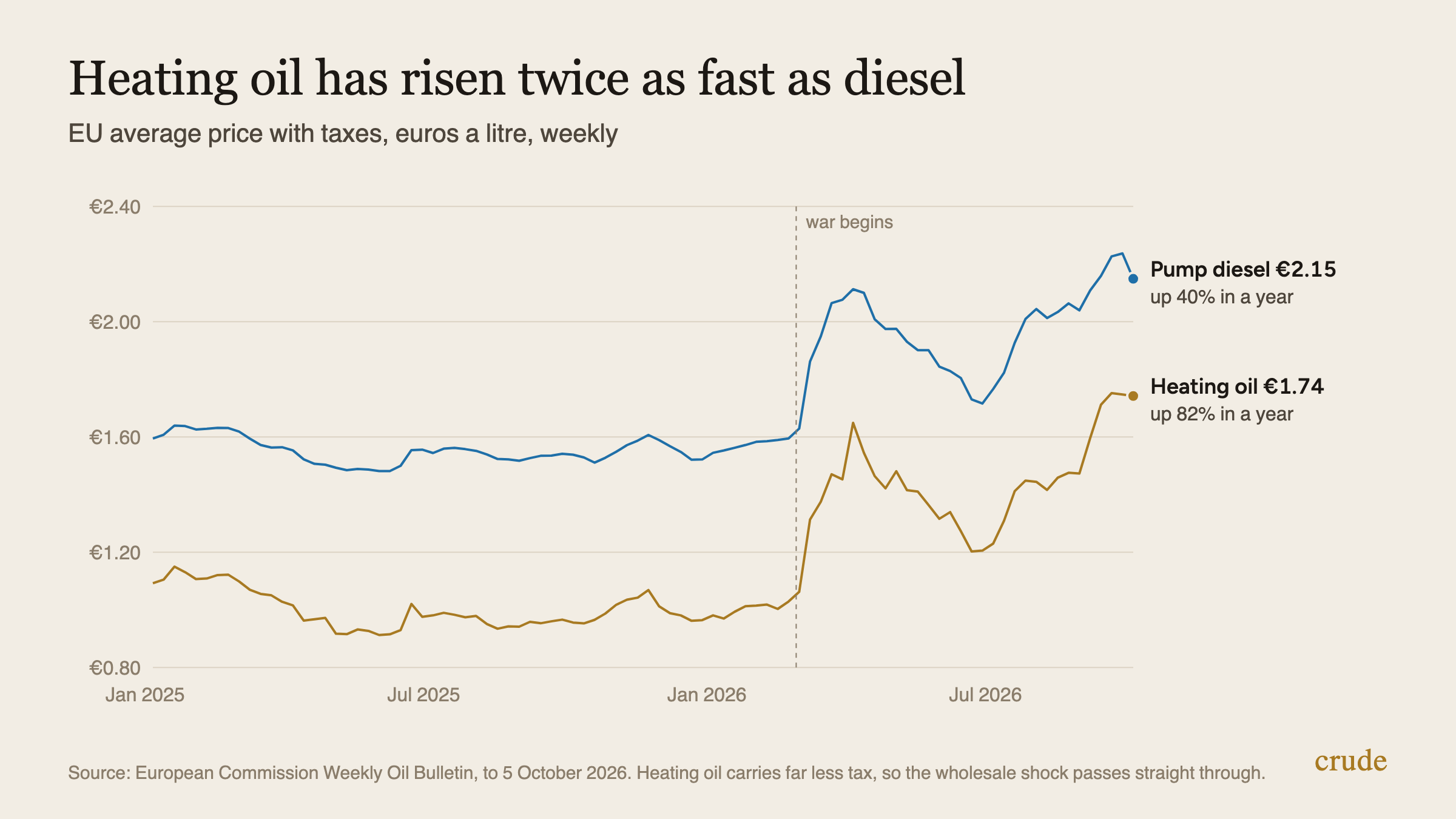
EU average prices with taxes, weekly. Source: European Commission Weekly Oil Bulletin.
Everyday prices are where the fear runs furthest ahead of the numbers. Fuel is roughly a fifth of what it costs to run a truck, and in the United States transport, storage and energy take only a few cents of every dollar spent on food. So even doubled diesel adds one or two percent to food through freight, before farm fuel and fertiliser. Euro area inflation for food, alcohol and tobacco was 1.4 percent in September, though food usually follows fuel by six months or more.
Airlines are a clearer casualty. IATA expects their fuel bill to rise by nearly two fifths this year, from roughly one quarter of all their costs last year. That points to costs, and fares if fully passed on, rising by around a tenth rather than in step with the fuel bill.
So the real lesson is narrower and more useful than the doom headlines. The crude is mostly arriving, slowly and expensively. The squeeze sits in ships and refineries, and it reaches households first through heating oil and diesel. The call: the EU average price of heating oil in the European Commission's Weekly Oil Bulletin stays above 1.50 euros a litre in every bulletin with a price date from 12 October 2026 to 30 November 2026. A single such bulletin below that level proves the call wrong.
Take Action
If you pay a European energy bill
- Order heating oil in two halves rather than filling the tank at once if you heat with oil. At the EU average of 1.742 euros a litre, a 3,000 litre fill costs about 5,226 euros. Every 10 euro cents the price moves is worth 300 euros on that tank, and splitting the order halves what a wrong guess on timing costs you.
- Plan for Germany's fuel tax cut ending on 31 December 2026 if you drive a diesel there. The tax then rises by about 16.7 euro cents a litre including value added tax, about 10 euros on a 60 litre tank.
If you follow the market
- Watch the diesel crack, not just Brent, because that margin is where this crisis is priced. A return to its September 2026 peak would mean the refining shock is deepening.
- Read the International Energy Agency's October Oil Market Report on 14 October 2026 for the first update on Russian and Gulf diesel exports since August.
- Count what actually sails. Moscow has cleared only part of the promised volume and its wider ban on diesel exports by producers runs to 31 October 2026, so Friday's deal is only real if November's tanker counts show Russian diesel exports climbing from September's decade low.
Standing watch: EU gas storage on Gas Infrastructure Europe's AGSI+ platform, free and updated daily.
This special edition was inspired by Max Fisher's video "The oil apocalypse is here", published on 2 October 2026. Every figure was checked and updated against primary sources to Friday 9 October 2026.
Follow Crude so the next one finds you.
Follow Crude on LinkedIn